
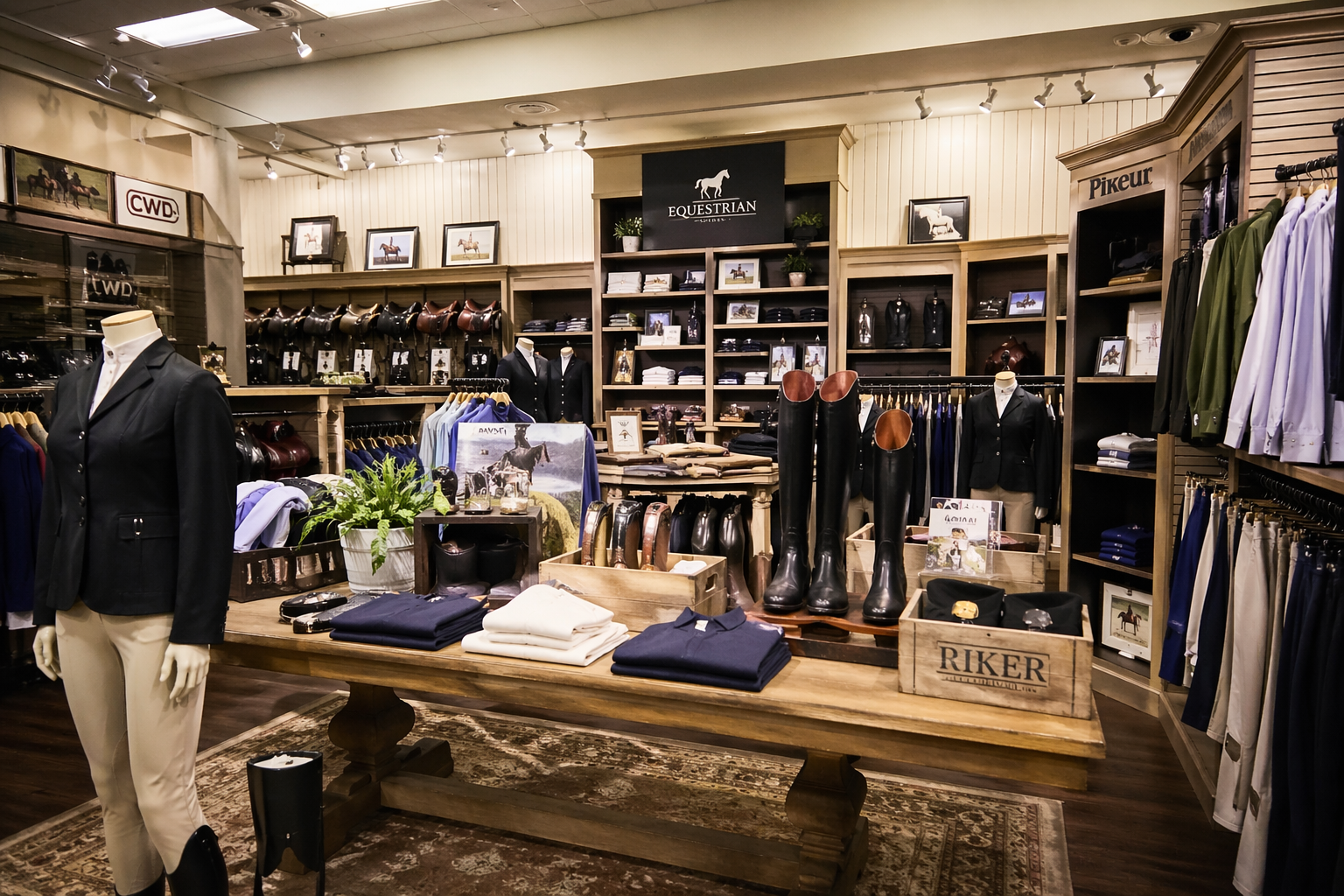
Securing shelf space — physical or digital — with American equestrian retailers is not a function of having a superior product. Plenty of exceptional European brands have approached US retailers with strong heritage, beautiful craftsmanship, and compelling price points, and walked away without a purchase order.
Understanding why requires understanding how American equestrian retail actually works, and what the people running these businesses need before they’ll commit to a new line.
Certainty of Supply
The first question every serious American retailer asks — sometimes explicitly, sometimes not — is whether you can actually supply them consistently. Not for the first order. For the third, the sixth, the reorder that comes in during peak show season when they need product in two weeks.
European brands without US distribution infrastructure have no convincing answer to this question. Transatlantic lead times, customs variables, and minimum order thresholds that don’t align with how American retailers buy make consistent supply genuinely difficult to guarantee. Retailers who have been burned by an imported line that went out of stock mid-season don’t take that risk twice.
Consistent, reliable inventory availability is the baseline. Everything else comes after.
Someone They Can Call
American retailers operate on relationships. The buyers and owners running equestrian retail — from large tack shops to boutique show vendors — want a point of contact who is reachable, knows the product deeply, and can solve problems without a six-hour time difference and a language barrier complicating every exchange.
This is not a criticism of European brands. It is simply the reality of how business gets done in this market. A US-based representative who can answer the phone, process a return, resolve a shipping issue, and show up at a buying appointment in person is not a luxury — it is a prerequisite for serious retail placement.
Retailers are not going to manage an international relationship on your behalf. That burden falls entirely on the brand, and without domestic infrastructure, it is a burden most European companies cannot realistically carry.
Margin That Works
American equestrian retailers operate on margin structures that are largely non-negotiable at the category level. Keystone — a 50% retail markup on wholesale cost — is the standard expectation across most equestrian hardgoods and apparel. Premium or specialty products can command slightly different structures, but not dramatically so.
European brands that price their US wholesale without fully accounting for import duties, freight, and currency exposure frequently arrive at a wholesale number that leaves retailers with inadequate margin. The retailer’s math is simple: if carrying your line means lower margin than comparable product, they will carry the comparable product.
Getting the landed cost and wholesale price right before approaching a single retailer is not a detail. It is the foundation of every conversation that follows.
Brand Coherence They Can Sell
American retailers at the luxury end of the equestrian market are curating an experience for their customers. They carry brands that fit a coherent story — heritage, craftsmanship, performance, provenance. They need to be able to explain to a customer why this brand is on their floor.
European equestrian brands often have exactly the story American retailers want. The problem is that the story hasn’t been translated for an American audience. Materials that resonate in the European market — technical specifications, federation approvals, regional heritage — need to be reframed around what American riders value and how American retailers communicate with their customers.
A brand that arrives with strong European positioning but no US-market narrative puts the translation burden on the retailer. Most won’t take it on.
Proof That Someone Is Committed
Perhaps the most underappreciated factor in American retailer decision-making is evidence of commitment. Retailers have seen too many European brands treat the US as an experiment — present for one buying cycle, absent the next, inconsistent on marketing support, and gone entirely if the first season doesn’t produce immediate results.
What retailers want to see is a brand that has made a real decision to be in the US market. That means domestic inventory, domestic representation, domestic marketing support, and a partner structure that signals permanence rather than trial.
A committed US distribution partner is the clearest possible signal a European brand can send. It tells every retailer in the conversation that this brand is here to build something, not test the waters.
Bridgeway Equestrian Group
We work with European luxury equestrian brands to build the US market presence that serious retailers require — supply reliability, domestic representation, correct channel pricing, and the kind of long-term commitment that opens doors and keeps them open.
If you’re ready to approach the US market the right way, let’s talk.