
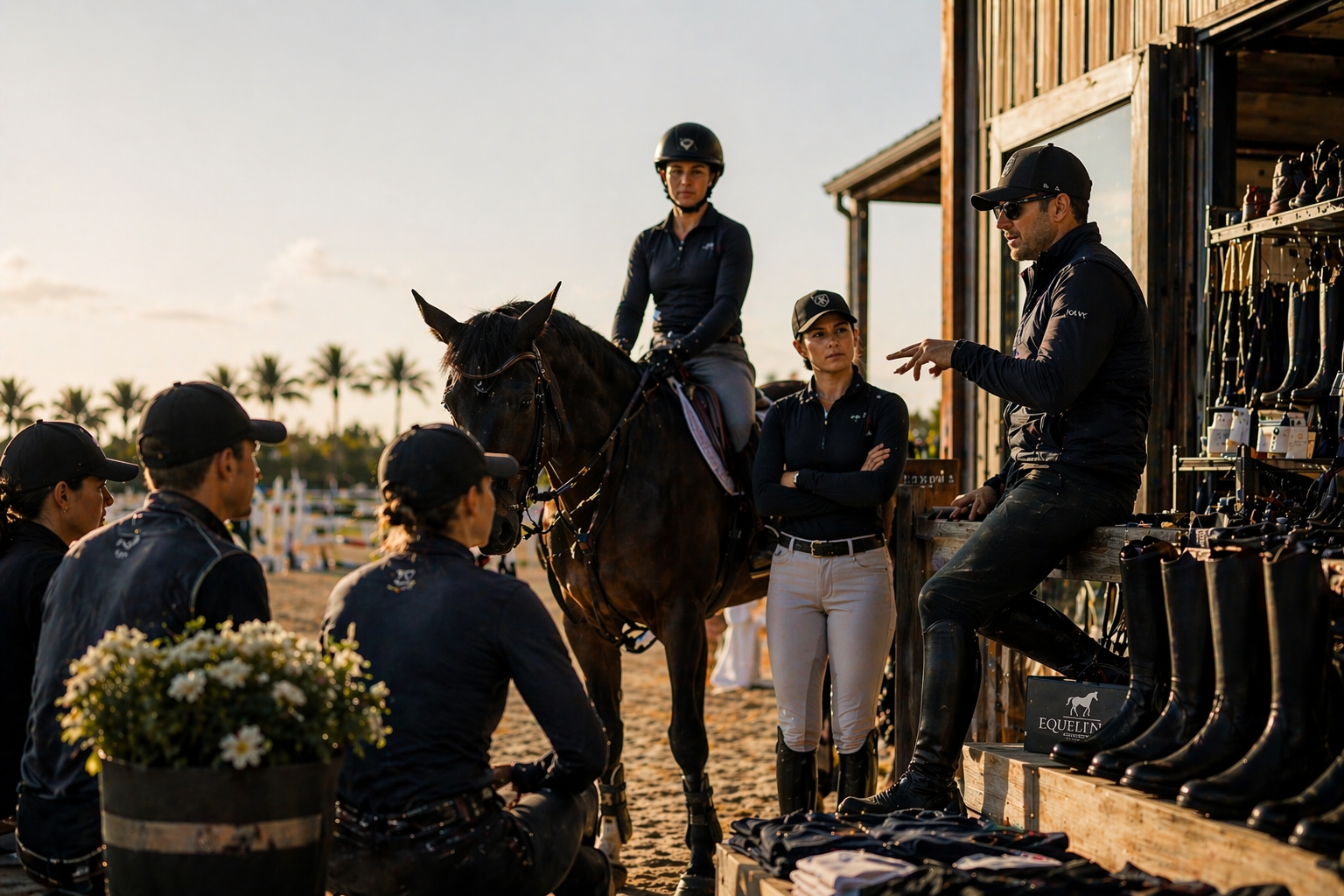
Ask any successful equestrian retailer in the United States where their best customers come from and the answer is rarely Google, rarely Instagram, and almost never a print ad. It is the trainer. The coach at the barn who told a student what saddle to buy, what boots to wear, what brand to trust. That recommendation — delivered in passing at the in-gate or during a lesson — drives more purchasing volume in the American equestrian market than any paid media campaign a brand could run.
For European brands evaluating US market entry, understanding the trainer relationship is not optional context. It is the central fact around which everything else should be organized.
Who Trainers Are and Why They Matter
The American equestrian trainer occupies a position of authority that has no precise equivalent in most European market structures. They are coach, advisor, style arbiter, and purchasing influencer simultaneously. Their students — who range from ambitious junior riders to adult amateurs writing significant checks for their hobby — trust their trainer’s judgment on equipment implicitly.
This trust is not casual. Riders at the competitive level spend years developing relationships with their trainers. They ride the horses their trainers recommend, compete in the divisions their trainers suggest, and purchase the equipment their trainers endorse. A trainer who favors a particular brand of boot, saddle pad, or riding coat creates a purchasing pattern across their entire client base that no advertising campaign can replicate.
At the upper end of the market — the Wellington, Thermal, and Ocala circuits where luxury equestrian spending concentrates — a single prominent trainer can influence purchasing decisions across dozens of high-net-worth clients. The math on that influence is significant.
How Trainer Relationships Actually Work
Trainer relationships in the American equestrian market are not transactional in the traditional sense. They are not simply influencer arrangements where a brand pays for a post and moves on. The trainers who carry real purchasing influence in this market are protective of their credibility with clients and selective about what they endorse.
The brands that earn genuine trainer advocacy do so through sustained relationship-building — product that performs at the level trainers expect, service that makes them look good in front of clients, and a presence on the circuit that signals the brand is committed to the market rather than sampling it.
This takes time. It also requires someone on the ground who knows the trainer community, can place product appropriately, and maintains those relationships through the full arc of the show season and beyond. It is not something that can be managed from Europe on a quarterly visit schedule.
Why European Brands Miss This Channel
European brands entering the US market tend to think in retail channels first — which retailers carry the product, what the shelf placement looks like, how the brand appears in a trade show context. These are not wrong considerations. But they are downstream of the trainer relationship in terms of actual purchasing influence.
A product that a trainer recommends will sell through whatever retailer carries it. A product that sits on a retailer’s shelf without trainer advocacy will move slowly regardless of how good it is.
The structural reason European brands miss the trainer channel is that it does not have a direct equivalent at home. European equestrian markets tend to be more retailer-driven, more federation-influenced, and less dependent on the barn-level coaching relationship as a purchasing catalyst. The dynamic simply doesn’t translate directly, and brands that map their European go-to-market approach onto the US market miss the most important channel in it.
What Building Trainer Relationships Actually Requires
Earning trainer advocacy requires product that earns it — that is the baseline. But assuming the product is there, what it takes operationally is consistent circuit presence, the ability to get product into trainers’ hands without friction, responsiveness when something needs to be resolved, and the patience to build trust over multiple seasons rather than expecting immediate results.
It also requires knowing who the right trainers are. The American equestrian trainer community is large and varied. Not every trainer carries meaningful purchasing influence with a luxury-level client base. Identifying the trainers whose endorsement actually moves product in the right demographic — and building relationships with those specific individuals — requires market knowledge that takes years to accumulate.
This is precisely why distribution partnerships matter beyond logistics. A distributor with deep circuit relationships already knows the trainer community. They know who influences purchasing at the luxury end of the market, who is open to new brands, and how to introduce a European line in a way that earns consideration rather than skepticism.
Bridgeway Equestrian Group
The trainer relationships we have built across the American show circuit are among the most valuable assets we bring to the European brands we work with. We know this community. We are present on the circuit. And we know how to position a new brand in front of the right people in a way that builds genuine, lasting advocacy.
If you make a product that performs at the level American trainers expect, we know exactly how to get it in front of them.